Followers

Showing posts with label Irish. Show all posts

Friday, July 17, 2026

Shakos and Bayonets 1798 -The United Men


We had an earlier look at the United Irishmen and suggested some Shakos and Bayonets unit statistics. Today we can look at our units to date. 


For convenience I'm using a blanket set of statistics. In reality after the first few victories even those initially too timid to Rise turned up for duty. Such men would not be trained as the United Irishmen were. Something for later I think. 

Above, four units of pike men each with a scattering of muskets. I do wish I had bought another four cavalry men. Ah well.


Our first two units with their officers. The mounted fellows might be the Irish Republicans returned from France. They were ardent revolutionaries and mostly Protestant. The rank and file except in Ulster were mainly Catholic. The "People of No Property" as Wolfe Tone said. The combination of Catholic, Protestant and Dissenter accounts for their designation as the United Irishmen. This is the period when green becomes the Irish national colour. It had appeared earlier of course in the flags of the the Confederation of Kilkenny. This time it envisaged no foreign allegiance.  As the song has it " I joined the United Men to fight for the Green."


Our second two units. I had thought to provide one unit with a Father Murphy figure by way of period flavour. In keeping with the instruction of the Catholic Hierarchy Father Murphy evinced no sympathy for the Revolutionaries. That changed when the Yeomanry burned down his chapel. With the heather blazing he called his parish to arms. One to ponder.

I think I can manage to put together another 12 figure unit of Pike Men. A more singular unit is the men of Shelmalier with their long barrel guns. Their function is clear they operated as skirmishing marksmen. Obtaining suitable figures is beyond me. I'm substituting these musket armed lads from Chariot and Lancashire Games archive range. True 15mm and excellent.


Of course the above unit only vaguely resembles the actual men of Shelmalier. No long barrel guns. The Revolutionary Phrygian/Liberty caps are not attested in Ireland so far as I know. 


The French Revolutionaries seem to have adopted it as it was worn by by Roman Freedmen. A sartorial "Slave No More" if you like. British cartoonists of the period loved the image of a monkey faced man in a Liberty Cap as visual shorthand for the United Men. So that is a sort of period connection. Likewise the striped trousers could only have been obtained from French allies.


The figures themselves are very nice. Two from Chariot and three from Lancashire Games Archive Vendee range. 

That's it. I'm grateful to Ian Kay at Irregular Miniatures for making the '98 Range above.  I'm frustrated by John at Khurasan for not releasing his '98 Range below. 


John let us see the first 15mm samples. 


A species of cruelty really.


Friday, June 5, 2026

Shakos and Bayonets for Ireland 1798


The best way to adapt a game is to do as little damage as possible to the original. At least that’s my belief. What follows is my first take on troop types for Ireland 1798. Before we get into the nitty-gritty let us bag an easy win. British or French Regulars are rated as- British and French Regulars! Who knew? We will get to them a later post. Meantime here is a pic of the first battalion of the 70e Demi-Brigade.


Now for another easy one. Of the Yeomanry Cavalry British General Lake opined “ A danger to everyone but the enemy.”  They were on his side. Where can we find a Shakos and Bayonets equivalent? I’m opting for Russian Opolchenie Cavalry. Obviously they will have to lose their lances. Otherwise, not a bad fit. Here are the stat’s.


Type

Discipline

Shooting

Aggression

Defence

Militia

Conscript

7+

6+

6+


Equipment

Traits

Sabre and pistol

Cavalry, Cowardly

I’m not sure about the pistol. A bit more digging needed there. A good first pass all the same.

Now to the Irish Militia. The Militia were created to keep an eye on the Yeomanry. This they seem to have been happy to do. They were less keen on fighting the United Irishmen.  Sometimes they just ran away. Fortunately Shakos and Bayonets has lots of Militia examples. They are much of a muchness. I have opted for the Austrian Landwehr one. Here we go. The Light Company of the Monaghan Militia-a work in progress.


Type

Discipline

Shooting

Aggression

Defence

Militia

Recruit

6+

7+

6+


Equipment

Traits

Musket

Close order, Idle


As you might expect the negative traits of both of the above do reduce the cost of per unit. Should you want to improve their chances you can attach a Militia Officer at additional cost.

There’s more. The Militia had both Light and Grenadier Companies. The Grenadiers should at least have been the biggest men. I don’t know if the Light Companies were really trained adequately enough for separate stats. Another thing to find out. The Militia Grenadiers might have better Aggression.

It’s back to Russia for my first pass on the United Men. I’m going with the Musketeers (Line Infantry). Why so? As General Suvorov said “The Bayonet is  wise, the Bullet a fool”. A translation, and variants abound. The United Irishmen were mostly pike armed and highly motivated. If they closed they likely won. The trick was to shoot them down before they did. Here are the Stats.


Type

Discipline

Shooting

Aggression

Defence

Line Infantry

Trained

7+

6+

5+


Equipment

Traits

Mostly Pike

Close order, Swordsman trait.


If you know little of ’98 you may wonder at the Trained rating above. Here is Joseph Holt a United Irishmen Commander “My pikemen were the most difficult to manage. I had to teach them to step in time, to face about, counter march, wheel about, but particularly to disperse and form rapidly, and to march in quick or double quick time." You will note Holt did teach them.

What of Shooting? Here is Myles Byrne, another Commander, "For twenty pikemen that kept together, with two or three with fire-arms, was quite sufficient to keep the best of those (Yeomanry Cavalry) corps at a respectful distance."

We will explore all this subsequently. The Wild Fowlers of Shelmalier with their long barrelled guns also need our attention. I will add here, one unit of them only.

All the same a good start.

Less toys than usual and I'm sorry for it. I thought it best to clarify our categories. By way of compensation I intend a post on the available figures for '98.   Next time we will look at the Yeomanry Infantry and others who eluded the first cut. 

Sunday, November 16, 2025

England's Allies and Mercenaries in 1513


Here we are at last. The Valois French are complete. Likewise, the host of the King of Scots. Now we turn to the English. Or nearly so.

First let us see the  Allies/ Mercenaries. Those being the Burgundians and the Irish and various bits of the Emperor’s Army. The Emperor’s men were genuine allies. The Burgundians and Irish had to be contracted and paid. Top of the page and below Burgundians.


The Burgundian Gendarmes above.


A Burgundian Lance. We see the front rank of Gendarmes and the second supporting rank of mounted crossbow men. This was the favoured Burgundian formation. Note the smaller horses in the second rank.


Burgundian mounted Crossbows who could deploy separately.


 Imperial or Burgundian skirmishing shot.


The splendid Burgundian flags are from Pete's Flags.

Cardinal Wolsey wanted to hire 1000 Irish cavalry for the 1513 Campaign. Wolsey looked after the important stuff for Henry. Diplomacy, Finance, Legislation that sort of thing. Doubtless he was a sharp lad. 


The horsemen he was looking for came from Ireland’s Warrior Clans. A 1000 of them wouldn’t leave many left in Ireland. Let me explain. An Irish Warrior Clan was an agnatic Mercenary Company. It owned no land and made its living by hiring out for wages and grazing in Ireland’s regular small wars.


Had Wolsey succeeded in hiring them he would have gained some excellent light cavalry and have removed a significant military group from Ireland. Smart work. 


In the event it seems he failed. Probably over money. In another negotiation Wolsey haggled about the number of servants each Kern expected  to take to France.


Some Kern did go to France so a deal was done. Here are some above and below.


Wolsey might have got some Irish Cavalry.  They are not, as far as I know, attested in the record. 

All the same, if you want to use some think Stradiots as far as capability goes. "The finest Scourrers on Christian ground." as the man said about them. I wouldn't go with more than one unit of Irish cavalry in 1513 France.


One though, adds to the fun.


Before we go, have a gander at the pic' above.  It is Henry King of England in 1513. Gold armour is hard to miss. I wonder if he wore it in the field? My version will.


Next time in 1513 we will see the English cavalry. Pete's Flags above with Essex Miniatures.

Monday, August 11, 2025

The Dark Daughter's Body Guard - The Nine Years War in Ireland


Above, the Crawfords under the O'Donnell flag. They constituted the body guard of Iníon Dubh (The Dark Daughter).  She was the mother of Red Hugh O'Donnell and was a Scots Lady of no mean political skills. These she surely inherited from her mother who also married an Irish dynast.

The body guard was part of her dowry. The lads were chosen individually for their size and strength. It turned out that the Crawfords specialised in biguns. The Flag is one of Ray's of Don't Throw a 1.

Annoyingly I think I have made a mistake with my figure selection. Consider this:

 "This was accordingly done for her (Iníon Dubh) for they rushed to the place where Hugh was, and proceeded to shoot at him with darts and bullets, until they left him lifeless; and there were also slain along with him the dearest to him of his faithful people."

The "they" in question are the Body Guards. Note the use the Irish Dart and some of them are using guns, probably Calivers. This is the first mention of Highlanders using darts that I have come across. The guns are less of a surprise. They were about and becoming more so. My choice was the typical West Highland bow and great sword/axe. Ah well, time to think again.

More properly the Dark Daughter was Fíonnghuala Ní Dhomhnaill. Her father MacDonald of Dunyveg and the Glens. Her mother Lady Agnes Campbell wife to Turlough of the Wine, The O'Neill. 

I thought you might be interested to read  her reviews:

The Annals of the Four Masters noted  she was "like the mother of Maccabees who joined a man's heart to a woman's thought."

The historian and biographer O'Cleirigh stated "for she was the head of the advice and counsel of the Cenel Conaill." 

Myler Magrath, the cleric and multiple turncoat, said she was "A cruel, bloody woman who has committed sundry murders".

Well yes, politics was always a deadly business. The point was, and still is, to win. Mother and daughter were adepts.


Above Scots Gaels. They could be a mercenary company or mobilised Clansmen.


The Irish branch of Clan Donald above. The McDonnells of the Route in Antrim. They had displaced the McQuillans some time past. The equally Gaelic McQuillans were the descendants of adventurers of Norman origin. Some of Clan McQuillan were still about. As indeed, they are still.

For the McDonnells things were looking up. They could field a force of 500 men without any real effort. If more were needed they arrived from the West Highlands in swift galleys.


My second unit of English Border Horse. The troopers are from Essex Miniatures and the officer and trumpeter from Khurasan.


Two Khurasan mail clad Irish cavalry and a QRF/Khurasan mix of targeteers. The estimable Clib' tells me Khurasan are to produce  a pack of Irish targeteers. Excellent news.


QRF Kern with a Khurasan Piper. Old fashioned Kern were on the way out but could on occasion be found in both English and Irish forces. They still had their moments. A brave English Captain was rallying his Company at the Ford of Biscuits. A Kern threw a dart through the Captain's neck, killing him. End of rally. 


Two common types of Irish attack tactics. Above caliver men supported by cavalry. Below, the same supported by Targeteers.


I mentioned previously that I was writing rules for the Nine Years War in Ireland. The job is now done. When I have further news I'll report it here.


Monday, May 26, 2025

The Nine Years War in Ireland -Reading The Cards


I like card powered games. Mostly the cards represent individuals, units, actions or events. Turn a card and an individual or a unit does something or an event happens. What sort of events happened on Nine Years War battlefields in Ireland?


Weather certainly happened.


On one occasion the rival Armies simply marched past each other because the rain made fighting impossible.


At the Moyry Pass the fog was so dense that the English shot their own men returning from reconnaissance. Twelve men out of thirty were lost.


What about the volatility of Black Powder? Yes, notoriously so. At the Battle of the Yellow Ford. Scores were wounded or killed when a powder cart went up. The card, above right, shows an English officer's drawing of that event. 


Lucky shots? Yes, Sir Henry Bagenal and Hugh Maguire of Fermanagh both fell to lucky shots. Many more too, not all of them fatal. Call it disrupted command in either case.


Military Madness has its place too. Situations where inherent military probability was simply ignored in pursuit of glory. Consider Sir Henry Cosby going over the trench at the Battle of the Yellow Ford. Or perhaps the charge of the Irish cavalry at Kinsale.

Running out of ammunition was also a problem in Ireland. Not so much the bullets but the powder. English accounts are replete with officers complaints that units had “burned off” all of their gunpowder. 


At Clontibret O’Neill’s shot burnt off all theirs too. How happy then when re-supply appeared.


Looting stopping play? Yes, we can add that. It is how the English Army escaped at the Ford of the Biscuits.

Ambush? Most certainly, we can add ambushes to our list. The Pass of Plumes comes to mind.  Below, you can see my latest completed units. 


Exceptional Training? It can be observed with the naked eye  and it pays off too. As the English Officer noted “Rory Og O’ More’s soldiers were the best men of war in the kingdom.”


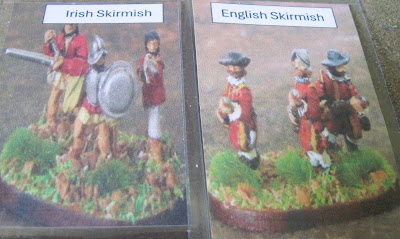
I’m making some cards for my Nine Years War in Ireland game. You can see some of them on this page. 


The officer cards are starred to indicate varying command abilities. I imagine I'll be doing quite a few of these as I paint the figures. On that, Khurasan do a very nice 15mm Mountjoy. He will be a 3 Star Commander of course.


These cards are very rough and ready. I needed something quick for play testing. Once the full card deck is done I'll post it here.


I'm minded when I first started playing Piquet, and its siblings, of the plethora of custom cards available. Some of them quite lovely in terms of artwork. The bulk of which were produced by individual enthusiasts.


Next on this one we will see a play test.