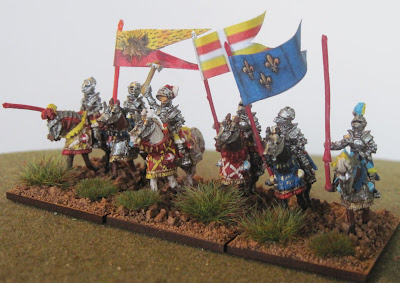
| Pretty good Stradiots from Blue Moon. |
A Venetian influence for these Blue Moon Stradiots. Another stronger unit below. I actually have Stradiots from Venexia and Mirliton too. All are good figures. I guess I just like Stradiots.
So said Aodh Mhor O'Neill, Earl of Tyrone when asked to provide his son as a hostage. It came to mind as we modern folk approach another watershed in the onward march of history. It also coincides with my new found interest in the Great Northern War. So, I chose it as a blog title.
| Pretty good Stradiots from Blue Moon. |
A Venetian influence for these Blue Moon Stradiots. Another stronger unit below. I actually have Stradiots from Venexia and Mirliton too. All are good figures. I guess I just like Stradiots.
After much delay I've returned to the Great Italian Wars. First on my to do list was completing the Swiss Pike units. All of them intended for the French Army, hence the profusion of white crosses. I had two units complete and one to do. The outstanding one was one of the biggest so I prevaricated. Above Venexia's offering and a fine one it is. Lots of variety.
Below, we have the Blue Moon Swiss.
Another pic' of the same troops in a deeper formation. Note that these fellows mainly lack armour even in the front ranks. They have the long white plumes indicative of young Swiss heroes. Accordingly, in Gonzalo, they will mover faster than their compatriots-themselves no slouches at the rapid advance.
There is much to commend the Blue Moon figures, not least an abundance of poses. Next, we see mainly Legio Heroica figures, once more variations abound, with a few Blue Moon thrown in. Call this band the interim stage.
Finally, the completed unit and the complete Swiss contingent. There's over 100 figures all told.
With officers from Blue Moon, one for each unit. Swiss command was collegiate.
Lastly,from Museum Miniatures.
An Organ Gun, this one is destined for Imperial or Spanish Service. So, I found myself on a roll, a Swiss roll in fact. That's not a sentence you often get to write.
Consequently, I have finally got to the Imperial Landsknechts, the French ones are already done. Four bases done so far, that's 24 figures. I'll be able to cheat of course, deploying back ranks to and from either formation.
Version 2 of my Gonzalo rules for The Great Italian Wars has been printed out too. A game is imminent.
It is of interest to note that alongside the rise of firepower the humble javelin or dart still had its place on the battle field. It was, as it always had been, an effective man killer.
There was a codicil, the user had to be brave, strong and skilled to achieve the desired effect.
The investment was required in the technology rather than the man. Fire arms were expensive and needed to be well maintained. Likewise good gunpowder required expert manufacture, it had to be kept carefully and was used up quickly. Crucially, it could defeat even the best armour. It was a revolutionary technology.
I envisage French crossbow men operating in swarms swift in advance or retreat. Of course dense blocks of pike men made very good targets and had to be screened by their own loose order missile men. Pike men couldn’t stand too long under skirmish fire.
Effective skirmishing required a great deal of good order and management. That might not always be available. Even when present such men were always vulnerable to any type of cavalry.
Part of the charm of the Great Italian Wars is that the old and the new existed side by side and the new was still a work in progress.
Accordingly, I’ve made artillery potentially devastating. Arquebusiers are more effective against armoured men and yet remain vulnerable to all other troop types. It’s a balance.
As Gonzalo is a Card driven game each unit needs to be readily identifiable when their card comes up. As in life the swiftest method is a distinctive flag. I found that there are many units but too few distinctive flags available.
As a final thought I may introduce a Master Gunner Card. Coming up next- a game of Gonzalo.
Cavalry could be complex. Consider the French Gendarme, he is organised by the Lance. This is where complexity begins. The Lance consists of the gendarme himself and depending upon the period a varied number of followers. The followers themselves have different functions. There should be archers and pages.
On occasion they perform both functions.
The pages don’t get much of a write up but we see them, I think, now and then. Sometimes they are operating in a group murdering the wounded and unhorsed gendarmes from the other side. There might be the chance of ransom if someone aristocratic passed by. Otherwise, it was a rainy night in Pavia for the stricken.
Sometimes the archers didn’t have any bows and fought as lance armed heavy cavalry. Sometimes they had bows but were terrible shots, couldn’t hit a Palazzo with a Lira De Braccio type of thing. On other occasions they had bows and were proficient in their use of them. They might dismount to shoot or might not. The type of bow used could vary, crossbows and long bows and short bows were all possible.
The only constant in an Ordnance Lance is the gendarme who is always a heavily armoured lancer. Even then he might have barding for his horse or not, or just a head piece or no protection at all. The archer appeared in a variety of forms
This means that if our sources say there were 100 Lances it could mean 300 men or 500 or more. It was conditional and all we can say is that it certainly doesn’t mean 100 men.
For my own convenience I’ve represented the French Lance of the Ordnance as a grand composite unit. First are the gendarmes, then the archers and then the true skirmishers. That is to say three units under one banner. I think that probably merits giving them a sub commander.
|
unit |
Number of ranks fighting |
Number of dice per base |
Special rules |
|
Gendarmes |
1 |
4 |
All units facing Gendarmes lose 1 D6 per base from their combat dice. |
|
Gentes De Arms |
1 |
4 |
When fighting un-barded cavalry, a score of 5 will cause a horse kill on the enemy unit. The rider can no longer fight with his unit. |
|
Ducal cavalry |
1 |
4 |
None |
|
Heavy cavalry |
1 |
3 |
None |
|
Stradiots |
2 |
2 |
Can evade. In the first round of combat any score of 6 by the Stradiots will cancel an opponent’s hit and add it to its own total. |
|
Genitors |
2 |
2 |
Can evade. In the first round of combat any score of 6 by the Genitors will cancel an opponent’s hit, and add it to its own total. |
|
Arquebusiers and Cross bows |
1 |
2 |
Can evade if charged |
|
General or Commander fighting |
|
|
The unit joined by the general rolls 1 additional D6 per base. |
You can see the sort of dynamics I want to model. I should add, I'm going down the Saving Throw route.
The figures above are from Venexia, Legio Heroica and Khurasan. I think they match each other well enough together.
While we are discussing Gonzalo I've made some progress on the Cards. Here you can see the Artillery and Charge Cards. I wanted them to look distinct from the Unit Cards and so used original artwork from the period .
More soon.